


Your UAE store is profitable, and the next question is where to sell beyond it. This Shopify Markets Middle East guide follows one example brand as it decides which GCC country to open first, how to set up the store, and how to avoid selling at a loss.
It is written for UAE and Saudi merchants who already know the basics of selling internationally. Part 1 covered market structure, translation, payments, shipping and compliance. This article applies those ideas to one regional expansion, with a decision for each country.
The short answer: start with one Shopify store on Shopify Markets. Treat each GCC country as a separate market with its own prices, range and delivery promise. Pilot one or two neighbours with a limited range, judge them on contribution margin rather than revenue, and then expand.
The Worked Example: Oud Lane, a Dubai Fragrance Brand
“Oud Lane” is a made-up Dubai fragrance and home-scent label on Shopify. It sells about 120 SKUs (perfumes, bakhoor, reed diffusers and gift sets) and ships everything from one warehouse in Al Quoz. It has one legal entity, which is registered in the UAE.
The founders want to expand into Saudi Arabia, Kuwait, Qatar, Bahrain and Oman, and possibly Jordan or Egypt after that. They have three concerns:
- Should they run one store or open a separate Saudi store?
- Will automatic currency conversion wipe out their margin once VAT, shipping and duty are added?
- Alcohol-based perfume counts as dangerous goods in transport. Can they ship it across borders reliably?
A Riyadh-based brand looking at the UAE and Kuwait can use the same method. Only the starting point and the order of countries change.
GCC Country-by-Country Decision Table
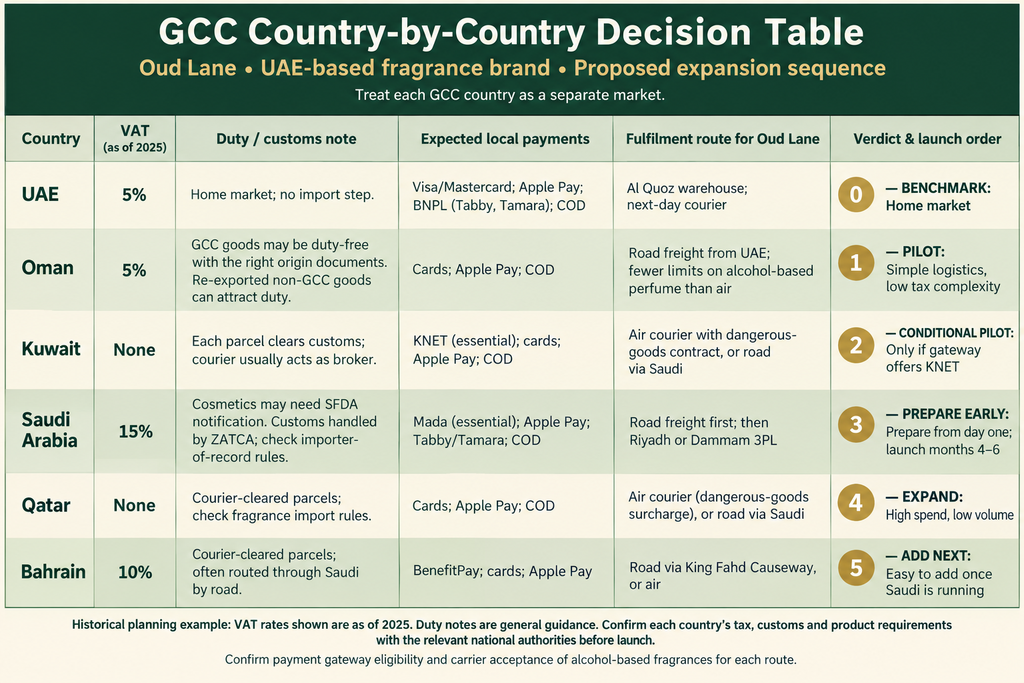
The most common mistake in cross border ecommerce Middle East planning is to treat the GCC as one market. Before choosing an order, Oud Lane fills in the table below. VAT rates are the published rates as of 2025. Duty notes are general guidance, so check every row with the national tax and customs authority before you launch.
Why Saudi Arabia Is Not First for Oud Lane
Saudi Arabia has the most GCC demand, and many UAE brands go there first. Oud Lane holds it back for operational reasons, not because demand is weak. Fragrance may need SFDA product notification, 15% VAT changes the margin, and buyers expect Mada and fast domestic delivery. Those take weeks to arrange, so the team starts that work in month one while Oman and Kuwait test the pricing and Arabic storefront at lower risk.
If a brand already has SFDA-compliant products and a Saudi 3PL quote, leading with Saudi Arabia is a reasonable choice. A Riyadh-based brand would usually go the other way, opening the UAE and Bahrain first. For a regulatory starting point, the Saudi Arabia e-commerce and logistics market map lists the relevant regulators. Confirm every legal point with those authorities directly.

Shopify Markets vs Separate Regional Stores
This structural decision is hard to reverse. Shopify’s Markets overview explains that one admin lets you group customers into markets and set currencies, pricing, product availability, storefront content, domains and languages for each.
When One Store Works
- You have one legal entity and one main warehouse.
- Most of the catalogue is the same in every country, with a few exclusions.
- One marketing team and one support team cover every country.
- You want reviews, inventory and SEO authority in one place.
That describes Oud Lane for its first 12 to 18 months: one theme, one set of apps, one inventory pool.
Operational Triggers to Split
- A Saudi legal entity with its own VAT registration, bank account and local payment contract.
- A local team that needs independent control of promotions, content and pricing.
- A storefront that has to differ a lot, such as different apps or checkout flows that Markets settings cannot handle.
- Local payment methods that a gateway will only offer to a locally registered business.
Split when operations require it, not because separate stores feel more local. A second store roughly doubles app fees, theme updates and reporting work.
Configuring Shopify Markets for Middle East Customers
The Shopify Markets help centre documents every setting. For Oud Lane, the setup order is:
- One market per country. Avoid a single “GCC” group, because prices and catalogues differ by country.
- URL structure. You can use subfolders (oudlane.com/ar-sa), subdomains (sa.oudlane.com) or country domains (oudlane.sa), as explained in Shopify’s guide to assigning domains and languages to markets. Subfolders keep all SEO authority on one domain and are the simplest choice.
- Languages. Add Arabic and English to each market. Arabic is the default for Saudi Arabia and Kuwait, English for the UAE.
- Catalogs and fixed pricing. Control which products each market sees, and set fixed local prices where the landed cost calls for it.
- Shipping zones. A market with no working shipping rate cannot check out.
If you also sell wholesale to regional retailers, read Shopify’s documentation on international B2B markets first.
Country-Specific Products and Pricing
Not every SKU belongs in every market. Oud Lane leaves large glass diffusers out of the Kuwait and Qatar air-courier catalogues because breakage and volumetric weight eat the margin. Heavy gift sets go only to markets it can reach by road.
A Landed-Cost Worksheet That Reconciles
Assumptions: the AED is pegged at 3.6725 per US dollar and the SAR at 3.75, so 1 SAR is about AED 0.979. Every figure below is illustrative and in AED. Payment fees are 3% of the gross price. The returns allowance is a percentage of net revenue. Use your own courier quotes, gateway rates and duty rulings.
UAE (home market), 100ml perfume:
- Gross price AED 250 including 5% VAT, so net price is AED 238.10
- Product cost: AED 70.00
- Local delivery: AED 20.00
- Duty: AED 0.00
- Payment fee (3% of 250): AED 7.50
- Returns allowance (4% of net): AED 9.52
- Contribution margin: AED 131.08 (55.1% of net)
Saudi Arabia, shipped from Dubai, fixed price SAR 289:
- Gross SAR 289 (AED 283.02) including 15% VAT, so net price is SAR 251.30, or AED 246.10
- Product cost: AED 70.00
- Cross-border delivery including dangerous-goods handling: AED 40.00
- Duty (conservative 5% on a declared value of about AED 110): AED 5.50
- Payment fee (3% of 283.02): AED 8.49
- Returns allowance (6% of net, because returns cost more cross-border): AED 14.77
- Contribution margin: AED 107.34 (43.6% of net)
Compare that with automatic conversion. AED 250 converts to about SAR 255, which is AED 217.39 net of 15% VAT. With the same costs (fee AED 7.50, returns AED 13.04), contribution falls to AED 81.35, or 37.4%. The fixed SAR 289 price brings back about AED 26 per bottle and looks like a deliberate local price point. This worksheet assumes VAT is collected once. Check with ZATCA how import VAT and your own VAT registration interact.
When to Set Different Prices
- Automatic conversion works for quick, low-volume tests.
- Fixed catalog prices make sense when VAT, duty and shipping shift margin by more than a few points, or when competitors anchor a price.
- Quarterly review: the AED, SAR, QAR, BHD and OMR are all pegged to the dollar, but KWD follows a currency basket, and courier rates change.
Shopify’s guide to customizing markets covers price adjustments, rounding and tax-inclusive display.
Shopify Arabic Localization for the Middle East
An Arabic storefront takes more than translated product pages. Shopify’s ecommerce localization guide makes the point that cultural and functional adaptation matter as much as the words.
Right-to-Left Checks With Concrete Failures to Catch
- Carousel arrows: in Arabic, “next” should point left. Many themes mirror the layout but leave the arrow icons unflipped.
- Mixed text: “SAR 289” or “100ml” inside an Arabic sentence can render in the wrong order. Check prices, SKUs and phone numbers such as +966.
- Cart drawer: on a 360px Android screen, quantity steppers often overlap Arabic product names.
- Checkout fields: Saudi addresses use the National Address short code. Add a hint field so couriers don’t fail deliveries.
- Numerals: decide whether to use Western (289) or Arabic-Indic (٢٨٩) digits, and use the same choice everywhere.
Product Content and Terminology
Shopify Translate & Adapt produces a quick first draft. A native Arabic reviewer should then rewrite scent notes and gifting copy. A literal “agarwood” loses the meaning that “oud” carries, and Gulf buyers search for “bakhoor”, not “incense chips”. Use market-level adaptation for country-specific lines such as Saudi delivery promises.
Campaigns and Post-Purchase Messages
- Plan around Ramadan, both Eids, Saudi National Day (23 September) and UAE National Day (2 December).
- Translate order confirmations, shipping notifications and return emails, not only the storefront.
- Offer WhatsApp support in Arabic and English, with response hours stated per country.
If your Arabic pages aren’t being indexed, our Shopify SEO team can audit hreflang tags and market URLs.
Currency Display vs Checkout Payments
Shopify’s international selling page says you can sell in more than 130 currencies. Showing a price in KWD is not the same as charging in KWD, though. Shopify Markets requirements and considerations states that accepting multiple currencies needs Shopify Payments or Adyen. With any other processor, every market pays in your store’s default currency.
The Reality for UAE and Saudi Merchants
As of 2025, Shopify Payments is not available to businesses based in the UAE or Saudi Arabia. Availability can change, so check Shopify’s current list of supported countries in the Help Center. Adyen is generally a fit for larger, enterprise-level merchants. In practice, most GCC merchants use regional gateways such as Tap Payments, PayTabs, Checkout.com, Telr or MyFatoorah. These usually charge the customer in the store’s default currency (AED for Oud Lane), even when the storefront shows SAR or KWD.
That means a Kuwaiti shopper sees KWD on the product page and is charged in AED. Show a clear note at checkout to prevent support tickets and chargebacks. For a Shopify multi currency GCC setup that bills in local currency, you need a supported processor or a separate store with a locally registered entity.
How to Verify KNET, Mada and BenefitPay
- Ask the gateway in writing whether it offers KNET, Mada and BenefitPay to a merchant registered in your country, and whether it works with Shopify checkout or uses an offsite redirect.
- Get the fee schedule for each method. Local debit schemes are often priced differently from international cards, and there may be setup or monthly fees.
- Confirm registration documents (trade licence, VAT certificate, bank letter) and the onboarding time for each method.
- Ask about settlement currency, refund handling and payout timing.
- Run real test orders with a local card from each country before launch.
Also, Shopify Markets is not the same as Shopify Managed Markets. Under Managed Markets, a partner acts as merchant of record for duties and taxes, but eligibility depends on where your business is based. Most GCC-based merchants configure Markets themselves and stay responsible for compliance.

GCC Ecommerce Fulfillment and Shipping Strategy
Delivery speed is part of what customers are paying for. A Saudi shopper who can get next-day delivery from a local brand needs a good reason to wait five days for yours.
Option A: Ship From the Home Country
- Pros: no extra inventory, fast to start, suitable for pilots.
- Cons: 2 to 6 days in transit, customs on every parcel, expensive returns.
- Perfume restrictions: alcohol-based fragrance is usually classed as flammable dangerous goods (UN1266). Many express carriers refuse it, limit quantities, or require a dangerous-goods contract for air shipments. Road services to Oman and Saudi Arabia are usually easier. Get each carrier’s restriction in writing.
Option B: A Regional Fulfillment 3PL Warehouse
- Pros: domestic delivery speed, local COD and returns, customs cleared once in bulk.
- Cons: inventory split across locations, storage fees, and possibly a need for a local importer of record.
Working out when to move: break-even orders per month = fixed monthly 3PL cost ÷ saving per order. Say a Riyadh 3PL charges a fixed AED 6,000 a month, and local delivery plus pick-and-pack costs AED 30 per order against AED 45.50 cross-border (shipping plus duty). The saving is about AED 15.50 per order, so break-even is around 390 orders a month. That ignores faster delivery and higher conversion, which often justify moving sooner. Use your own quotes.
Vetting a 3PL
- Licensed to store and ship dangerous goods, including fragrance
- A native Shopify integration that syncs inventory as a location
- Next-day delivery coverage in Riyadh, Jeddah and Dammam
- COD remittance timing and fees
- Returns inspection and restocking turnaround
- Whether it can act as importer of record, or works with one
Customs, Duty and Importer of Record
Choose between DDP (you pay duty and include it in the price) and DDU (the customer pays on delivery). With DDU, unexpected charges cause refused parcels that you pay to bring back. For bulk 3PL stock, someone has to be the importer of record. That could be a local entity, the 3PL or a licensed broker. The rules differ by country and product, so check HS codes, duty-free thresholds and fragrance rules with each customs authority. Shopify’s duties and import tax settings can help with display and collection where supported, but compliance remains your responsibility.
How to Expand Ecommerce in the GCC With Shopify: Oud Lane’s Roadmap
Phase 1: Prepare (Weeks 1 to 4)
Oud Lane picks Oman and Kuwait as pilots, builds landed-cost worksheets for its top 20 SKUs, signs a gateway with KNET support and confirms road and dangerous-goods carriers. It starts the SFDA and Saudi 3PL work at the same time.
Phase 2: Pilot (Weeks 5 to 16)
It launches 25 easy-to-ship SKUs with copy approved by a native Arabic reviewer. A rough pilot budget, as an example only: AED 5,000 for Arabic review and RTL fixes, AED 15,000 a month in paid social per pilot country for three months, and AED 3,000 for test orders and gateway setup. That is about AED 98,000 for two countries.
Phase 3: Measure
- Conversion rate against the UAE benchmark
- Checkout completion by payment method (KNET in particular)
- On-time delivery and failed deliveries
- Return rate and return cost per order
- Contribution margin per order
- Support contacts per 100 orders
Phase 4: Expand or Fix
Set your threshold before launch. One useful rule is that the pilot’s contribution margin covers its acquisition cost per order with room to spare. If Kuwait passes, Oud Lane widens the range and launches Saudi Arabia in months 4 to 6, followed by Qatar and Bahrain. If it doesn’t, the team fixes pricing or fulfilment before adding anything. Jordan and Egypt come later, each with its own decision table.
Conclusion: From Local Brand to Regional Business
Going from one country to six comes down to operational decisions made in the right order. A clear Shopify Markets Middle East plan lets you test Oman and Kuwait cheaply, prepare Saudi Arabia properly and protect your margin at each step.
If you need the basics first, go back to Part 1, our guide to selling internationally on Shopify. When you are ready to build, explore our Shopify store development services or contact the Seamedia team to plan your GCC launch.
FAQ
Can I sell to all six GCC countries from one Shopify store?
Yes. Shopify Markets lets you create separate markets for the UAE, Saudi Arabia, Kuwait, Qatar, Bahrain and Oman in one store, each with its own prices, catalog, language and domain. A separate store usually only makes sense once you have a local legal entity, a local team or payment access that requires one.
Is Shopify Payments available for UAE or Saudi-based merchants?
As of 2025, no. Check Shopify’s current list of supported countries because availability changes. Most GCC merchants use regional gateways, which usually charge in the store’s default currency even when local prices are shown.
How do I offer Mada and KNET on Shopify?
Use a regional gateway that supports them. Get written confirmation that each method is available to a business registered in your country, along with fees, required documents, settlement currency and refund handling. Then place real test orders with local cards before launch.
Should I use automatic conversion or fixed prices in the GCC?
Automatic conversion is fine for quick tests. In higher-cost markets such as Saudi Arabia, with 15% VAT, a fixed catalog price protects margin. In our worked example, a fixed price recovered about AED 26 per bottle compared with conversion.
Does Shopify handle GCC duties and taxes for me?
Only partly. Shopify Markets helps with tax display and, where supported, duty collection. Managed Markets has eligibility limits based on where your business is located, so most GCC merchants remain responsible for VAT, customs and product compliance.
