


CAFIT MERGE FUTURE 2027 is the Calicut Forum for IT’s business collaboration event, taking place on January 9 and 10, 2027, at Calicut Trade Centre. It brings entrepreneurs, industry leaders and professionals together to meet, exchange ideas and explore partnerships that can shape what comes next for local businesses.
In Calicut, many good deals still start with a conversation over tea. This event is built to create more of those conversations.
This guide is for Calicut retailers, manufacturers, service providers and anyone thinking about going digital. It covers what the event is, why it matters, what selling online involves in practice, and how to turn a two-day event into a small, measurable pilot.
What Is CAFIT MERGE FUTURE 2027?
MERGE FUTURE is CAFIT’s flagship business event. According to CAFIT’s MERGE FUTURE 2027 announcement, it is designed as a platform for business connections, knowledge exchange and strategic partnerships across industries.
The theme is “The Grand Shift Is No Longer a Story.” Change in business is already happening, and innovation, collaboration and adaptability decide who grows. The core message, “Interact. Connect. Go Beyond,” invites businesses to look past their usual circle of contacts.
| Detail | Information |
|---|---|
| Event name | MERGE FUTURE 2027 |
| Organiser | Calicut Forum for IT (CAFIT) |
| Dates | January 9 and 10, 2027 |
| Venue | Calicut Trade Centre, Kozhikode |
| Theme | “The Grand Shift Is No Longer a Story” |
| Core message | “Interact. Connect. Go Beyond.” |
| Focus | Business collaboration, networking, knowledge exchange, partnerships |
For programme, participation and registration details, refer to the CAFIT announcement linked above.

Why MERGE FUTURE Matters for Calicut Business Networking
Most small business owners in Kozhikode are busy running shops, factories or service teams. There’s rarely time to go looking for new partners. A focused event like the CAFIT MERGE FUTURE 2027 business event puts many of those people in one place for two days.
Meet entrepreneurs outside your usual circle
A textile retailer usually knows other textile retailers. A food manufacturer knows its distributors. Cross-industry events create introductions you wouldn’t get otherwise, such as a spice producer meeting a logistics startup, or a furniture maker meeting a web development team.
Exchange ideas that save you expensive mistakes
Talking to a business owner who launched an online store last year can teach you more than any brochure. You’ll hear about their real delivery problems, which payment setup caused trouble and how long it took to get regular orders. That peer knowledge is a big part of what B2B networking in Kozhikode offers.
Find partners with skills you don’t have
The best partnerships match one business’s strengths to another’s gaps. A manufacturer with great products but no online presence fits naturally with a technology company that builds stores. CAFIT’s stated aim is to help businesses explore exactly these partnerships.
Turning Connections into Digital Growth: Seamedia’s Perspective
This section reflects Seamedia’s perspective as an e-commerce and digital services company. It is not part of CAFIT’s event material.
In our view, businesses rarely struggle online because the product is weak. More often, the product, the operations and the technology haven’t been connected properly. Here are three common ways Calicut businesses and digital providers can work together.
Retailers and technology companies
Picture a family-run clothing store near SM Street with loyal walk-in customers. A technology partner could help it build an online catalogue, sync shop stock with the website and send WhatsApp order updates. Customers who moved to Bengaluru or the Gulf could still buy from a shop they trust.
Manufacturers and commerce specialists
A Calicut maker of coconut-based products or bakery goods might sell almost everything through distributors. A commerce partner could help it test direct-to-consumer (D2C) sales with a small online range and customer data the business owns. The distributor channel continues alongside it.
Service providers and digital tools
Clinics, training institutes, interior designers and travel agencies sell services, not boxes. For them, digital growth might mean online booking, payment links, review management and local search visibility. A good partner recommends only the tools that solve a real problem.
Five questions to ask any technology partner
- Who owns the store, domain and customer data if we stop working together?
- Can you give an itemised quote separating setup, apps, theme, payment charges and monthly support?
- How will the store connect to our billing, GST invoicing, stock and courier, and what stays manual?
- What will our own team need to do each week, and who trains them?
- What will we measure in the first 60-90 days, and how will you report it?
If you’re comparing routes, our page on e-commerce website development explains the main options in plain language.
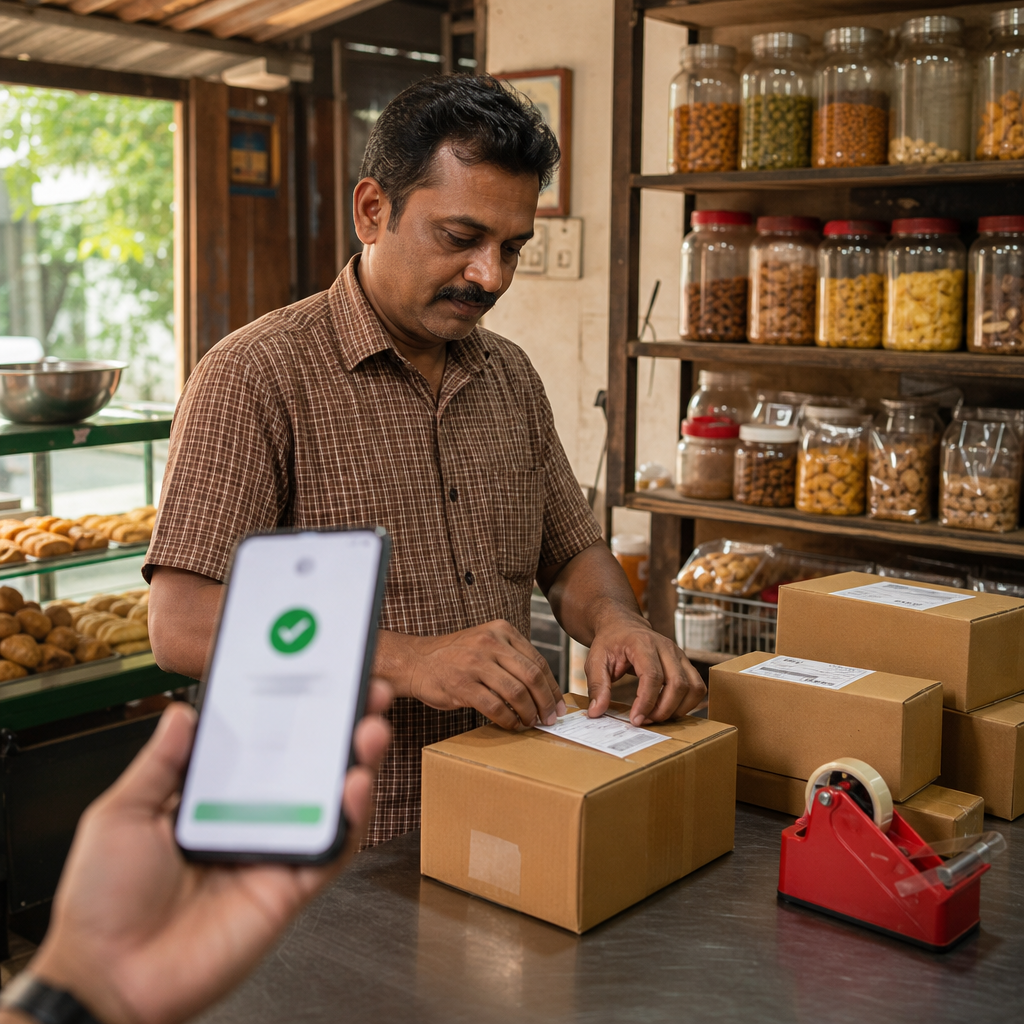
E-commerce Growth in Calicut: Opportunities for Local Brands
For national context, India’s e-retail market was estimated at US$65-66 billion in 2025, according to the Bain & Company and Flipkart report covered in Moneycontrol’s report on India’s e-retail market. That is a national trend, not a Calicut forecast, so test your own products and customers first. The practical side matters more.
Step 1: Launch a store that fits your operations
Hosted platforms such as Shopify India let you launch without building from scratch. Before choosing a plan, check:
- Catalogue size: 30 products and 3,000 SKUs need very different setups.
- Language and currency: Do you need Malayalam content, or AED prices for Gulf customers?
- Integrations: Does it connect with your billing software, courier and payment gateway?
- Total monthly cost: Plan fee, apps, theme and payment charges together, not just the headline price.
Our walkthrough on setting up a Shopify store covers these choices step by step.
Step 2: Sort out GST for online sales
Selling online changes your tax paperwork. Speak to your chartered accountant before launch about GST registration rules for online sellers, invoices for each order, and how marketplace sales differ from your own website. If you plan to sell through marketplaces, ask how tax collected at source (TCS) will appear in your returns.
Step 3: Set up payment gateways and UPI
UPI is the default for many Indian shoppers, so your checkout should support it smoothly alongside cards and net banking. Compare gateway providers on transaction fees, settlement time, refund handling and KYC requirements. Decide early whether you will accept cash on delivery, since it affects returns and cash flow.
Step 4: Plan couriers, returns and customer support
- Delivery: Handle Kozhikode orders yourself, or use a courier aggregator for wider India.
- Packaging: Food, glassware and garments each need different protection.
- Returns: Write a clear policy covering who pays return shipping and how refunds work.
- Inventory sync: Online and shop stock should update together.
- Support: Decide who answers WhatsApp, calls and emails, and how fast.
Step 5: Budget team time and money for a pilot
A pilot needs people, not just software. Expect someone to spend regular hours each week on product photos, listings, packing, dispatch and customer replies. For costs, ask for itemised quotes from each provider and set a fixed spending cap for the pilot period before you begin.
Step 6: Reach markets beyond Calicut
| Channel | Best for | Trade-off |
|---|---|---|
| Own D2C website (e.g. Shopify) | Control over pricing, customer data and presentation | You bring your own traffic through marketing |
| ONDC network | Being found through multiple buyer apps on an open network | Onboarding goes through network participants; check fit |
| Large marketplaces | Fast access to existing shoppers | Commissions, price competition, limited customer data |
| Social and WhatsApp commerce | Small catalogues and relationship selling | Hard to scale without order systems |
The Open Network for Digital Commerce (ONDC) explains how sellers take part. Suitability depends on your category, margins and capacity. For background, see the IBEF Indian e-commerce industry overview.
How to Prepare for CAFIT MERGE FUTURE 2027
Turning up without a plan is the most common networking mistake. You collect visiting cards and nothing happens afterwards. Use this checklist before January 9.
- Define one business challenge. “Our online orders are stuck at 20 a month” beats “we want to grow online.”
- Write a 30-second introduction. Who you are, what you sell, who buys it and what partner you need.
- List partner types. A web developer, logistics provider, packaging supplier or marketing agency.
- Prepare your numbers. Monthly sales range, product count, average order value and current channels.
- Bring examples. Product photos, a catalogue PDF or your website on your phone.
- Block follow-up time in the week after the event.
- Set a realistic goal. Three strong conversations beat fifty visiting cards.

After the Event: Turning Conversations into a Pilot
The real value of any business event shows up in the weeks after. Here’s a simple timeline.
Week 1: Follow up while it’s fresh
Send a short message within 48 hours. Mention what you discussed and suggest one next step, such as a 30-minute call or a site visit.
Weeks 2-4: Agree on a small pilot
Agree a clear scope, spending cap and timeline. For example, a Kozhikode halwa and snacks brand might list just 10 best-sellers, ship only within Kerala for 60 days and track three numbers: orders, average order value and delivery complaints.
Months 2-3: Review and decide
Compare results with expectations. If it works, expand the range or delivery area. If not, find out whether price, photos, delivery cost or traffic was the issue. A partner who helps answer that honestly is worth keeping.
Building Calicut’s Business Community Together
CAFIT says MERGE FUTURE aims to help make Calicut a dynamic destination for business networking, industry engagement and entrepreneurial collaboration. That matters for every business in the region, not just tech companies.
When local retailers and manufacturers work with local technology providers, more value stays in the region. Developers learn the real problems of local trade. Traditional businesses get partners who understand Malabar’s customers, festivals and buying habits.
Digital transformation for local brands in Calicut doesn’t mean copying a Bengaluru startup. It can be a trusted shop taking orders from Dubai, or a small manufacturer finding first buyers in Pune.
Key Takeaways
- CAFIT MERGE FUTURE 2027 runs January 9-10, 2027, at Calicut Trade Centre, organised by the Calicut Forum for IT.
- Its focus is collaboration, networking, idea exchange and partnerships: “Interact. Connect. Go Beyond.”
- Selling online means planning GST, UPI and gateways, couriers, returns and weekly team time, not just a website.
- Ask tech partners about data ownership, itemised costs, integrations, your team’s workload and measurement.
- Arrive with one challenge and a follow-up plan, then turn the best conversations into a capped, 60-90 day pilot.
Conclusion: Make MERGE FUTURE Your Starting Point
CAFIT MERGE FUTURE 2027 gives Calicut businesses a chance to meet entrepreneurs, technology companies and industry leaders under one roof. The businesses that gain most will turn handshakes into partnerships and small, well-run pilots.
Start preparing now: pick your biggest challenge, gather your numbers and decide what partner you need. Follow CAFIT’s MERGE FUTURE 2027 announcement for programme and registration news.
If you want help planning a store launch, connecting operations or reaching customers beyond Kerala, talk to the Seamedia team about your next step.
FAQ
What is CAFIT MERGE FUTURE 2027?
CAFIT MERGE FUTURE 2027 is a flagship business event from the Calicut Forum for IT. It brings together businesses, entrepreneurs, industry leaders and professionals to network, exchange ideas and explore partnerships, under the theme “The Grand Shift Is No Longer a Story” and the message “Interact. Connect. Go Beyond.”
When and where is MERGE FUTURE 2027 held?
The event is scheduled for January 9 and 10, 2027, at Calicut Trade Centre in Kozhikode, Kerala. For programme and registration details, refer to CAFIT’s official MERGE FUTURE 2027 announcement.
Who should attend CAFIT MERGE FUTURE 2027?
Retailers, manufacturers, service providers, technology firms, entrepreneurs and professionals. It suits Calicut businesses looking for new partners, fresh ideas or practical routes to digital growth, such as launching an online store or reaching customers outside Kerala.
What should I bring to the event?
Bring a 30-second introduction, one clearly defined business challenge, key numbers such as monthly sales range and product count, and examples like product photos, a catalogue PDF or your website on your phone. Also block time in your calendar for follow-ups the week after.
How do I follow up with contacts after the event?
Send a short message within 48 hours that recalls your conversation and proposes one specific next step, such as a 30-minute call or a site visit. Then agree a small pilot with clear scope, a spending cap and a review date.
I’m a small business with no website. Is the event still useful?
Yes. The event focuses on connections across industries, so it is a good place to meet people who have already gone online and to learn from them. Talk to them about GST, payments, couriers and team time before you choose a platform or partner.
