

Overloaded metafields — Metafields become a dumping ground with no structure, validation, or reuse. Finding and updating data is a nightmare.

The Product Data Chaos Problem
When catalogs grow and product data gets complex, native Shopify and generic apps quickly hit their limits. The result is chaos: inconsistent data, no governance, and ERP–Shopify mismatch.
-
-
Inconsistent product data —Same attribute named differently across products; missing specs, broken formatting, and duplicate content. Quality and trust suffer.
-
Poor content governance — No single source of truth. Marketing, merchandising, and ops all edit product data in different ways with no approval or standards.
-
No approval workflows — Changes go live without review. Errors and incomplete content slip through, especially in multi-language or multi-market stores.
-
ERP–Shopify mismatch — ERP holds the real product and inventory data; Shopify becomes a manual copy. Sync is one-way, fragile, or non-existent. Duplicate effort and errors.

Our Shopify-Native PIM Solution
A custom-built Product Information Management system for Shopify — not a generic app.
Seamedia’s Advanced PIM for Shopify is designed for brands with large catalogs, multi-attribute products, and ERP-integrated operations. We deliver structure, governance, and scalability so your product data stays clean, consistent, and under control.
Custom admin interfaces
Purpose-built UIs for product managers and content teams. No more wrestling with raw metafields or spreadsheets; you work with forms, dropdowns, and validation that match your data model.
Structured attribute models
Define attributes, specs, and content types once. Reuse across products and variants. Enforce formats and required fields so data quality stays high.
Shopify metafields + external logic
We use Shopify metafields where they fit and layer external logic where Shopify falls short. You get enterprise-grade product data management without leaving the Shopify ecosystem.
Scalable architecture
Built for catalogs from thousands to hundreds of thousands of products. Bulk operations, background jobs, and API-first design so product data management scales with your business.
What We Integrate
End-to-end data flow between Shopify and your ERP.
Centralized product data model
One coherent model for attributes, specifications, and content. Define product types, required fields, and validation rules so every product follows the same structure.
Rich content blocks (A+ style content)
Structured rich content for product pages — modules, comparisons, FAQs, and marketing copy. Control layout and reuse blocks across products without duplicating or losing governance.
Approval workflows
Route product and content changes through review before they go live. Reduce errors and keep quality high, especially for multi-language and multi-market catalogs.
Multi-language product content
Manage product titles, descriptions, and attributes per language or market. Keep translations in sync and publish only when ready.
Attribute & specification management
Manage technical specs, dimensions, materials, and custom attributes in a structured way. Reuse attribute definitions across products; support multi-value and variant-level data.
Version control & audit logs
Track who changed what and when. Roll back to previous versions when needed. Full audit trail for compliance and troubleshooting.
Bulk updates (CSV / API)
Update thousands of products via CSV import/export or API. Map columns to your data model; validate and apply in bulk so large catalogs stay manageable.
Variant-level data control
Store and manage data at the variant level — size-specific copy, variant-level specs, or per-SKU attributes. Full control without overloading the product.
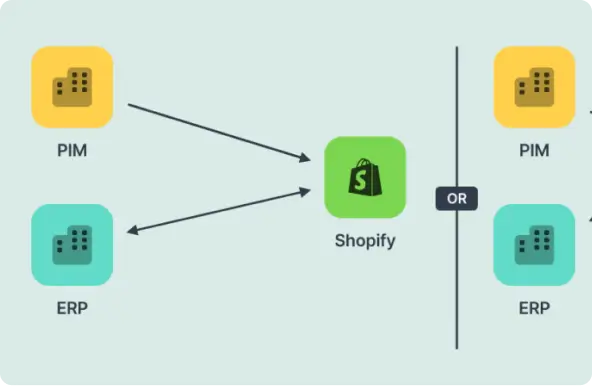
ERP & External Data Sync
Keep Shopify in sync with your source of truth.
- ERP as source of truth — Your ERP (SAP, Odoo, custom, or other) holds master product and inventory data. Our PIM and sync layer treat it as the authority; Shopify receives controlled, transformed data.
- Controlled sync into Shopify — Sync runs on schedule or on demand. Only approved and validated data flows in. You decide which fields come from ERP, which are managed in PIM, and which stay manual in Shopify where it makes sense.
- Field-level mapping — Map ERP fields to Shopify product, variant, and metafield structures. Transform values, merge sources, and handle multi-language or multi-market rules in one place.
- Error logging & rollback — Failed records are logged with clear reasons. Fix at source or in mapping, then re-run. Roll back specific sync runs if needed so you never lose control.
Use Cases
Where our Shopify PIM and product data management deliver.

Electronics specifications
Structured specs (wattage, dimensions, compatibility), tech sheets, and rich content. Keep product data consistent and easy to maintain across thousands of SKUs.

Fashion attributes
Size charts, materials, care instructions, and variant-level copy. Multi-language and multi-market product content with approval workflows.

Pharmacy product compliance
Regulatory and compliance attributes, batch data, and approval workflows. Ensure only approved, compliant content goes live.

B2B catalogs
Customer-specific attributes, bulk data, and ERP-driven product and pricing data. Keep B2B catalogs in sync with back-office systems.

Why This Beats Apps
Custom Shopify PIM vs. generic product data apps.
- Performance — Built for your catalog size and data model. No generic app overhead or limits; we optimize for your store.
- Flexibility — Your attribute model, your workflows, your ERP mapping. No fighting an app’s one-size-fits-all structure.
- Ownership — You own the logic and the data. No vendor lock-in or subscription limits on fields or products.
- Custom business rules — Validation, approval flows, and sync rules designed for your business — not a generic template.
Bring Enterprise Product Governance to Shopify
Get structure, governance, and scalability for your product data. Talk to a solutions architect or request a demo to see how our PIM system can work for your catalog.