









Custom ERP + Shopify Integration Experts
Why a Purpose-Built Shopify Integration Module Matters for Custom & Proprietary ERPs
A custom ERP reflects years of investment in workflows, compliance, and master data rules that do not exist in packaged software. Shopify, meanwhile, expects modern JSON APIs, webhooks, and predictable idempotency. The gap between those worlds is where revenue leaks, inventory drifts, and finance teams lose trust in e-commerce numbers. A dedicated Shopify integration layer for custom ERP translates your business rules into reliable sync jobs, validates payloads before they hit either system, and gives operations a single place to monitor failures — instead of brittle spreadsheets and one-off scripts.
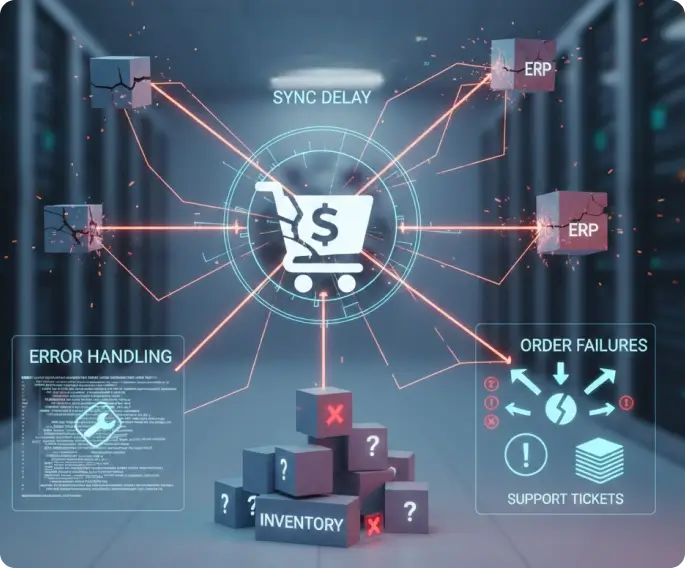
Generic tools fail
- No mapping for your ERP’s custom tables or legacy IDs
- Batch jobs that lag during peak season and cause oversells
- Opaque errors when Shopify or your ERP rejects a payload
- No path to upgrade APIs without breaking production sync
What we deliver
- Middleware aligned to your authentication and network zones
- Field-level mapping to Shopify products, orders, and metafields
- Queues, retries, and dead-letter handling for enterprise volume
- Documentation and runbooks your IT team can own long-term
Seamedia engineers integration modules against Shopify Admin API, GraphQL, Bulk Operations, and webhooks, paired with whatever your ERP exposes: REST endpoints, message buses, JDBC read replicas, or file drops. We treat your custom ERP Shopify connector as a product: versioned releases, sandbox parity, and monitoring hooks so DevOps and finance both gain confidence.
API & legacy connectivity
Catalog & variant sync
Inventory & locations
Orders & financial alignment
Gift cards & promotions
Multi-store & global
The Most Capable Approach to Custom ERP and Shopify Integration
Powering reliable B2C and B2B operations when your ERP is unique to your organization.
Powerful integration architecture
Whether you process hundreds or millions of orders, we structure Shopify custom ERP integration around clear boundaries: ingestion from your ERP, transformation and validation, and outbound calls to Shopify with rate-limit awareness. Horizontal scaling, idempotent webhooks, and partitioned queues keep throughput predictable when marketing campaigns spike traffic.
Full-featured, bespoke workflows
Prebuilt app store connectors assume a standard ERP schema. We implement your order lifecycle, return reasons, tax logic, and customer hierarchies. That means custom discount rules, contract pricing for B2B, and line-level attributes flowing end to end — not lost in translation between systems.
Unparalleled integration expertise
Our team combines deep Shopify Plus experience with enterprise integration patterns: OAuth and HMAC security, secrets rotation, ERP change windows, and runbooks for Black Friday. You get a partner who has shipped custom ERP middleware in regulated and high-SKU environments, not a generic offshore script.
Featured Use Cases for Custom ERP Shopify Integration
Automate the processes that matter most when your ERP was built in-house or heavily customized.
Order management
Process orders faster. Improve visibility.
Automatically sync Shopify orders and payouts into your ERP’s sales or OMS tables, preserve channel identifiers, and accelerate fulfillment handoff while reducing manual entry errors.
Shipping & fulfillment
Ship faster. Stay in control.
Connect warehouse or 3PL status back to Shopify fulfillments and tracking URLs so customers see accurate delivery state tied to ERP-backed inventory movements.
Returns management
Faster refunds. Happier customers.
Automate return authorizations, restocking, and refund transactions so inventory and GL entries stay aligned between Shopify and your custom ERP.
Product data management
Improve listing accuracy. Lift conversions.
Sync product masters, attributes, media references, and pricing rules from your ERP to Shopify variants and metafields, eliminating listing drift across channels.
Inventory management
Prevent stockouts. Protect revenue.
Push location-level availability on schedules and event triggers so Shopify never sells inventory your ERP has already allocated elsewhere.
Payouts & reconciliation
Close faster. Control cash.
Map Shopify payouts and fee lines into your ERP’s cash and clearing accounts with traceability to gateway batches and order IDs.
Customer data management
Know your buyers. Drive repeat sales.
Synchronize customers, company accounts, and purchase history so support and sales work from the same record in ERP and Shopify.
B2B management
Simplify wholesale. Scale confidently.
Align Shopify B2B companies, catalogs, and payment terms with ERP contract pricing and credit limits without duplicate admin work.
POS management
Unify online and in-store.
Flow POS orders and exchanges into your ERP with store and register metadata so retail and e-commerce inventory reconcile cleanly.
Global market management
Expand globally. Operate locally.
Automate multi-currency and regional pricing feeds from your ERP into Shopify Markets while respecting tax and compliance fields your finance team owns.
Custom field & metafield sync
Preserve ERP intelligence on the storefront.
Map proprietary attributes and compliance flags to Shopify metafields and metaobjects so merchandising and PDP content reflect ERP truth.
Observability & support
See failures. Fix fast.
Centralized logs, alerts, and replay tools for your integration team so incidents are actionable instead of hidden in inbox threads.
End-to-End Custom ERP Shopify Integration — Data Flows We Automate
Below is how we structure Shopify sync with a custom ERP for brands that cannot rely on off-the-shelf apps. Every flow is designed around your APIs, master data rules, and operational SLAs. This is the full scope of our custom ERP integration module engagements.

Product & Catalog Sync With Full Attribute Mapping
We deliver bilateral or one-way product sync between your custom ERP and Shopify depending on which system owns the golden record for titles, descriptions, variants, images, barcodes, and pricing. Your ERP may store products in normalized tables with legacy keys; we map those keys to Shopify product and variant IDs, maintain stable handles, and support bulk imports through Shopify Bulk Operations when catalogs exceed REST rate limits. Custom attributes — materials, hazmat flags, regional compliance codes, or internal merchandising tiers — flow into Shopify metafields with namespaces and keys your theme and apps consume. Incremental updates use webhooks or polling strategies that respect both Shopify API budgets and your ERP’s batch windows. When merchandisers edit content in Shopify, we can optionally sync selective fields back if your governance model allows, with conflict rules documented upfront. The outcome is a catalog that scales to tens of thousands of SKUs without CSV chaos.

Automated Inventory & Location Synchronization
Inventory synchronization from your custom ERP to Shopify must reflect how your business actually allocates stock: warehouses, stores, dropship nodes, or virtual buffers. We map ERP location or bin logic to Shopify Locations and tune cadence from near-real-time for hero SKUs to scheduled batches for long-tail items. Stock movements from receipts, transfers, adjustments, and production completions propagate as availability changes Shopify can sell against. Safety stock and reservation rules defined in your ERP can be mirrored so flash sales do not oversell committed inventory. When API hiccups occur, our queues hold deltas and replay them idempotently so counts converge after recovery. This layer is where most DIY integrations fail; we engineer it for peak weeks and for auditors who ask why on-hand matched what Shopify displayed at order time.

Order Ingestion & Fulfillment Loop
Shopify orders — including Shopify B2B, draft orders, and marketplace channels you enable — transform into the document types your ERP expects: open sales orders, pick tickets, or cash receipts. Line taxes, shipping lines, discounts, tip lines, and duties map with full traceability to the Shopify order ID and checkout token for chargeback research. Partial fulfillments, split shipments, and cancellation reasons round-trip to Shopify so customer service sees the same narrative your warehouse executes. When your ERP allocates serial numbers or lot IDs, we can attach that metadata back to fulfillment records. For high-volume brands, we shard processing so one poisoned order does not block the queue. This is the operational backbone of custom ERP Shopify order integration.

Refunds, Adjustments & Financial Alignment
Returns and payment adjustments must post to your ERP with the same rigor as new sales. We wire Shopify refunds and partial captures to your GL structure — whether you use summary cash postings or line-level AR — and preserve links to original transactions for audit. Exchange workflows can be modeled as linked refund-plus-new-order pairs when finance requires. Payment gateway references, gift card redemptions, and store credit applications carry through so month-end reconciliation between Shopify payouts and bank deposits does not become a forensic exercise. Tax inclusive versus exclusive handling follows your ERP’s tax engine outputs. The result is financial sync that finance trusts during close, not a parallel shadow spreadsheet.

Gift Cards, Store Credit & Liability
Gift card programs touch both marketing and accounting. We align Shopify gift card issuance and redemption with your ERP’s liability and revenue recognition policies — whether you track stored value as a dedicated subledger or as custom tables. Redemptions reduce outstanding liability in step with fulfillment. For B2B scenarios, corporate gifting and bulk issuance can sync as controlled batches. Edge cases like partial redemptions, combination payments, and cross-border gift cards get explicit mapping so support teams are not stuck reconciling mismatched balances between Shopify and the ERP.
Multi-Location, Multi-Store & Channel Rules
Enterprise retailers often run multiple Shopify stores or markets against one ERP. We implement rules for which SKUs appear where, how price lists apply, and which inventory buckets feed each storefront. Multi-location inventory logic in your ERP drives sellable quantities per Shopify Location, including ship-from-store and BOPIS scenarios when POS is in play. Channel-specific buffers prevent wholesale inventory from appearing on DTC, or vice versa, according to your strategy. When you add a new region or brand, the integration extends with configuration rather than a rewrite.

Shopify POS & Omnichannel Continuity
Shopify POS orders and returns enter the same pipeline as online orders, with store, register, and staff identifiers mapped to ERP cost centers or custom dimensions. Offline-tolerant POS behavior is reconciled once connectivity returns, so your ERP does not double-count or miss transactions. Exchanges spanning channels maintain inventory integrity across locations. For brands with showrooms and warehouses, this unification is what makes omnichannel reporting credible in the ERP.
Custom Fields, Metafields & Master Data Governance
Your competitive advantage often lives in ERP-only data. We document a field dictionary: each ERP column or API field maps to Shopify resources, metafields, tags, or line item properties, with clear master ownership and update direction. Data types, validation, and character limits are enforced before API calls fail in production. When ERP schema evolves — new compliance field, new product class — the integration ships as versioned changes with regression tests. This preserves the ROI of your custom ERP while making that intelligence visible on the storefront and in Shopify-powered apps.
Integration Architecture Built for Custom ERPs and Shopify at Scale
REST, webhooks, queues, and observability — not fragile point-to-point scripts.
Packaged iPaaS templates rarely encode your authentication headers, VPN paths, or ERP batch locks. We design middleware that respects your security perimeter while meeting Shopify’s expectations for OAuth, webhook verification, and API versioning.
Middleware Matched to Your ERP’s Interface
The integration service might run in your cloud tenant, ours, or hybrid depending on data residency. We connect via the mechanisms your team supports: HTTPS APIs with mutual TLS, SFTP drops, database read replicas with read-only credentials, or enterprise service buses. Transformation logic centralizes business rules so neither Shopify nor your ERP is littered with ad hoc triggers. Code is stored in version control with environments for development, UAT, and production, mirroring how you release ERP changes.
Schedules, Webhooks & Event-Driven Sync
Not every object should sync on the same clock. We combine Shopify webhooks for orders and inventory hooks with scheduled jobs for heavy catalog sweeps and nightly reconciliation. Back-pressure controls shed load gracefully when Shopify announces rate limit buckets or when your ERP enters maintenance. You get a tunable balance between freshness and infrastructure cost.
Queues, Retries & Idempotency
Spikes during launches or holiday windows are normal. Durable queues absorb bursts; consumers apply idempotent processing using Shopify and ERP keys so duplicate deliveries do not create duplicate orders. Retries use exponential backoff and circuit breakers to protect fragile legacy endpoints. Failed records land in a review queue with enough context for operators to fix data and replay safely.
Monitoring, Alerts & Runbooks
Dashboards show lag, error rates, and stuck jobs. Alerts route to Slack, PagerDuty, or email based on severity. Runbooks describe how to pause sync, drain queues, and roll back bad releases. This operational layer is what turns a project into a managed Shopify custom ERP integration your business can rely on for years.
Ready To Transform Your E-Commerce Business?
Let's discuss your project and create a custom solution that drives growth and success for your business.
Design, Develop, and Grow Your Store With Expert Support.
Transform Your E-Commerce Vision Into a Powerful, High-Converting Online Experience With the Support of Certified Shopify Experts, Creative UI/UX Designers, and Growth-Focused Digital Strategists Focused on Crafting Seamless User Experiences and Driving Sustainable Business Growth.


What Breaks When Custom ERP and Shopify Stay Disconnected
Disconnected systems create hidden tax on growth: slower cash conversion, higher chargeback risk, and brand damage from fulfillment failures.
Orders Fragment Across Channels
Without automated ingestion, operations teams manually re-enter orders or import CSVs that arrive stale. Promotions and tax lines get mis-keyed. Customer service lacks a single timeline tying Shopify events to ERP documents, so escalations multiply.
Inventory Becomes a Guessing Game
When custom ERP stock levels do not drive Shopify availability in near real time, you either oversell (and cancel) or over-buffer (and lose sales). Neither option supports aggressive growth or marketplace expansion.
Finance Loses Confidence in E-Commerce Numbers
Payouts, refunds, and gift card liabilities that do not tie to ERP postings force manual reconciliation and audit findings. Leadership cannot trust channel profitability dashboards built on incomplete data.
Product Data Drifts from Master Records
Merchandising teams edit Shopify while planners trust ERP attributes. Without governed sync, compliance labels, sizing, and hazmat flags diverge — exposing regulatory and customer-safety risk.
IT Debt Compounds
Each emergency script adds opaque dependencies. When key people leave, nobody knows how money moves between systems. A deliberate Shopify integration module for custom ERP replaces that risk with documented pipelines.
Industries We Serve With Custom ERP Shopify Integrations
Vertical expertise layered on top of a flexible integration core.
Fashion & Apparel
Matrix SKUs, pre-orders, and seasonal collections require tight alignment between ERP allocation rules and Shopify sellable inventory. We handle size curves, style-level attributes, and multi-brand storefronts.
Health & Beauty
Regulatory attributes, lot traceability where applicable, and subscription or replenishment flows integrate with ERP planning so compliance and commerce stay synchronized.
Industrial & B2B
Complex customer hierarchies, contract pricing, and approval workflows map between Shopify B2B and ERP without duplicate customer records or price leaks.
Food & Beverage
Expiry-aware inventory, multi-temperature logistics, and promotional calendars sync so DTC and retail channels respect shelf life and allocation rules.
Consumer Electronics
High-SKU catalogs with serials, warranties, and MAP pricing controlled in ERP flow to Shopify with metafields powering comparison and support content.
Home & Furniture
Dimensional weight, delivery zones, and white-glove services reconcile between checkout experiences and ERP fulfillment charges.
Our Custom ERP Shopify Integration Process
01
Discovery & API Audit
We inventory ERP entities, authentication, rate limits, and change windows. Shopify store structure, markets, and apps are mapped. Data quality gaps and master-data policies are documented before code starts.
02
Architecture & Mapping
Field dictionaries, sequence diagrams, and error-handling strategy are signed off by IT and operations. Non-functional requirements cover RPO/RTO, PII boundaries, and load tests.
03
Build & Test
We implement middleware, webhook endpoints, and schedulers in dev and UAT. Synthetic and historical loads validate edge cases: partial refunds, split fulfillments, inventory contention.
04
Cutover
Phased go-live with parallel reconciliation where needed. Rollback paths and communication plans involve stakeholders from warehouse to finance.
05
Operate & Evolve
Monitoring, incident response, and a backlog for new channels, fields, and stores. API version upgrades and ERP releases tracked for impact.
Integration Success Stories


Velocity International, UAE
Complex B2B and B2C operations required reliable inventory and order flow between Shopify and a proprietary ERP backbone. Our integration approach reduced fulfillment delays and improved inventory accuracy — the same delivery model we use for custom ERP and Shopify programs worldwide.
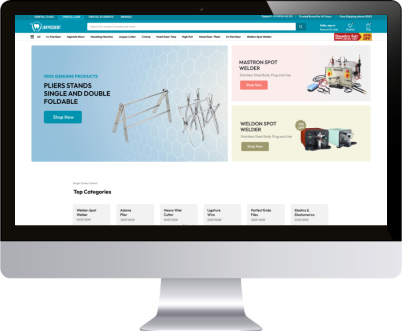

Jaypee Dent, India
Thousands of SKUs demanded automated catalog and order sync at scale. We eliminated duplicate data entry and improved order accuracy — principles we apply to every custom ERP Shopify integration engagement.
Why Expert Custom ERP Integration Beats DIY Approaches
Capability
DIY / Generic tools
Seamedia custom ERP + Shopify
ERP schema fit
Forces ERP into template shapes
Designed around your tables and APIs
Custom field mapping
Manual or missing
Documented dictionary to metafields
Peak traffic & queues
Frequent throttling and stuck jobs
Backpressure, retries, replay
Security & networking
Ad hoc credentials
Secrets, TLS, zone-aware design
Observability
Logs scattered in inboxes
Dashboards, alerts, runbooks
Lifecycle & upgrades
Breaks silently on API change
Versioned releases & regression tests
Shopify depth
REST-only quick fixes
GraphQL, Bulk Ops, B2B, POS
Latest Insights on ERP & Shopify Integration
Middleware patterns, Shopify Plus operations, and omnichannel strategy from our team.

The Silent Luxury Revolution in India: How Tier-2 & Tier-3 Cities Are Redefining Premium E-commerce — And Why Shopify Is Becoming the #1 Platform for Luxury Brands
For decades, India’s luxury map was predictable.Delhi, Mumbai, Bengaluru, Chennai, and Hyderabad controlled the narrative.Luxury lived in Khan Market, Palladium,...
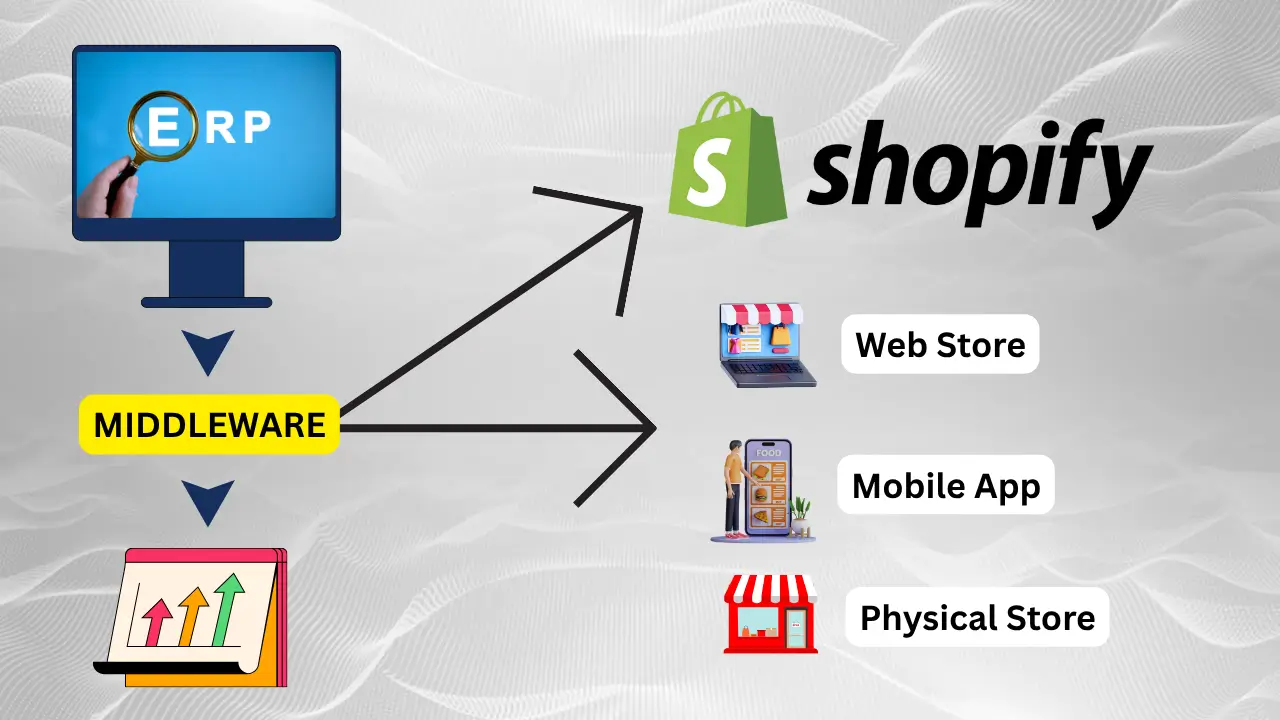
How We Implemented Real‑Time ERP to Shopify Stock Sync Using GraphQL for a Large‑Scale Pharmacy Chain in Qatar
Keeping inventory accurate and up‑to‑date is paramount for any high‑volume retailer. For Wellcare and Raf Pharmacy—two leading pharmacy chains in Qatar with over 10,000...

How Seamedia E-commerce Solutions Built a Unique “Buy 2 Get 1 Free” Offer for Leading Pharmacy Shopify Stores in Qatar
Introduction Promotions like “Buy 1 Get 1 Free” and “Buy 2 Get 1 Free” are classic retail drivers. But what...